
Chapter 5
Harassment and other threats to safety, security, and wellbeing
Introduction
Traveling for work can be exciting and an excellent opportunity to learn and share across cultures. However, there are risks associated with traveling for work. Being aware and preventing risks can optimize your travel experience. Do not be discouraged by the risks. This guidance is meant to help navigate a variety of situations. Packing a whistle that you carry with you can be an easy way to call for attention in an emergency situation.
When travelling for work across countries and cultures, understanding security risks and potential threats such as harassment is important to ensure and maintain one’s physical and mental safety, security, and wellbeing throughout the duration of the trip. Harassment, safety, security, and wellbeing have distinct yet interconnected meanings, each important for fostering a safe and supportive professional environment.
For a common understanding we provide some definitions on terms used in this chapter. Definitions may vary slightly across institutions and jurisdictions; readers are encouraged to consult their organization’s specific policies.
Harassment (REF 1): Harassment is any improper and unwelcome conduct by an individual or group of individuals that is directed at, and offensive to, another person and that the individual(s) knew, or reasonably ought to have known, would cause offence or harm to that person. Harassment does not have to be intentional or deliberate. Harassment may take the form of words, gestures or actions which tend to annoy, alarm, abuse, demean, intimidate, belittle, humiliate or embarrass another or which create an intimidating, hostile or offensive work environment. Harassment normally implies repeated incidents. Harassment includes sexual harassment and abuse of authority as they constitute specific forms of harassment.
Safety (REF 2): Safety focuses on the prevention of unintentional damage caused by physical hazards such as accidents or natural disasters.
Security (REF 2, REF 3): Freedom from fear, freedom from want, and dignity. ‘Security’ is related to the maintenance of peace and stability. Security deals with protection against intentional damage caused by external factors such as theft or cyber-attacks.
Wellbeing (REF 4): Well-being is a positive state experienced by individuals and societies. Similar to health, it is a resource for daily life and is determined by social, economic and environmental conditions. Well-being encompasses quality of life and the ability of people and societies to contribute to the world with a sense of meaning and purpose.
Cultural norms, gender roles, and laws may vary widely from one region to another, often influencing the way people experience safety, security, and wellbeing. Women, in particular, may face additional challenges such as harassment in certain countries where established ideas around gender roles can affect their professional interactions, credibility and personal safety, security, and wellbeing covered.
The objective of this chapter is to outline practical advice for female professionals on how to prevent and respond to certain threats to safety, security, and wellbeing and thereby how to navigate international work travels or “missions” safely and confidently. Drawing inspiration from guidelines including those from the Global Business Travel Association (GBTA) and the American International Group (AIG), this chapter provides a set of security and travel tips that, while tailored to women’s safety, offer valuable insights for anyone. The types of threats and the set of tips covered in this chapter are by no means exhaustive, but it is a good place to start. The responsibility for harassment and violence always lies with the perpetrator. Prevention strategies discussed in this chapter are intended to enhance situational awareness and preparedness—not to shift responsibility onto those who experience harm.
Types of threats to security, safety, and wellbeing
There are many types of threats to security, safety and wellbeing for professional women and members of the LGBTQIA+ community who are traveling for work. The types of threats to security, safety, and well covered in this chapter include harassment and gender-based violence. Chapter 13 specificlly addresses rape.
Harassment
There are many types of harassment, including aggressive pressure or intimidation, as described in the table below. There can be different layers and combinations of harassment such as due to skin colour or being from a specific ethnicity, being a woman or being an early-career professional. Harassment can escalate from discomfort to more serious incidents with physical and psychological consequences for the victim. There are also different contexts of harassment such as by the police, at the migration border, in the street and in the professional environment.
Harassment may involve experiencing unwanted sexual advances, receiving threatening or injurious, racist phone calls, emails, text messages or other communications through other social media, being followed or visited, or having your home or workplace watched.
Table: Types of Harassment
| Type of harassment | Description/ Examples |
| Discriminatory harassment | Racism
Harassment based on religion or ethnicity Office-based harassment based on gender |
| Power harassment | The improper use of a position of influence, power or authority against another person (1). This is particularly serious when a person uses his or her influence, power or authority to improperly influence the career or employment conditions of another. Abuse of authority may also include conduct that creates a hostile or offensive work environment. |
| Psychological harassment | Bullying including woman-to-woman; the use of force, coercion, hurtful teasing, comments, or threats, in order to abuse, aggressively dominate, or intimidate one or more others
Sabotage Mobbing |
| Sexual harassment | Any unwelcome sexual advance, request for sexual favour, verbal or physical conduct or gesture of a sexual nature, or any other behaviour of a sexual nature that might reasonably be expected or be perceived to cause offence or humiliation to another, when such conduct interferes with work, is made a condition of employment or creates an intimidating, hostile or offensive work environment (1). |
| Online harassment | Anonymous comments
Personally or group directed comments/social media posts (texts pictures, etc) of misogyny nature or power plays |
Harassment can occur across power hierarchies but often exploits asymmetries in rank, gender, nationality, age, or contractual status. International missions may intensify these dynamics due to isolation and informal social structures.
In the workplace, an uncomfortable or abusive working relationship very often starts small, sometimes as small as an incident or a disliking between two persons. Power often plays a significant role, making junior and female staff usually more vulnerable.
Furthermore, professionals have the misguided perception that “professional rules don’t apply” while on mission. Work travel can blur professional boundaries, particularly when colleagues spend extended time together outside formal office settings.Being on a mission may seem like an opportunity to “play” and “be free” in contrast to the strict social rules of the office. Furthermore, colleagues often spend more time off-hours together while on mission than when they are at the duty station, such as going sightseeing and eating dinner together. This discrepancy may create confusion about professional boundaries.
Harassment can also occur with strangers that you may never see again. To avoid this kind of scenario, it is important to know how to navigate public spaces. It is safest to stay in groups. People are easier targets when they are alone. Tell the people in the group if you are going elsewhere. Tell them with whom you’re going and where. Inform each other that you have made it home safely.
If harassment in a public space escalates into a dangerous situation where you or someone with you is threatened, carrying a whistle can be a way of drawing attention from people nearby.
It is natural and is encouraged that colleagues stick together while on mission, even when off duty, for activities such as sightseeing and eating dinner together. Safety for all members in the group is enhanced when colleagues stick together while on mission. However, it is important that such situations not be taken advantage of. Spending private time together is not an invitation to behave unprofessionally. See “prevention strategies” on how to mitigate such miscommunications while on mission.
Gender-Based Violence
Gender based violence (GBV), or violence directed at an individual based on their gender, is one of the most pervasive human rights violations in the world (UNICEF). It occurs in every country, across all segments of society. GBV entails any harm or threat of harm inflicted on a person because of male-female power imbalances entrenched within a society. It can come in many forms, including sexual or physical assault, domestic violence or intimate partner violence, and sexual violence and other violent or coercive acts. GBV can be physical, sexual, mental or economic in nature.
Women and girls face the greatest threat (UNHCR). Women travelers are especially likely to be targeted for these crimes. See Chapter 3 for more information on GBV in the context of cultural differences.
Men and boys can also be affected by gender based violence as is the case in most military conflicts, when they are obliged to go to military service and submitted to harassment because they are not heterosexual, etc. Additionally, transgender women and other gender minorities might be especially targeted and victimized by gender based violence.
Survivors of this violence suffer devastating consequences. Many experience severe physical injuries, unwanted pregnancies and exposure to HIV or other sexually transmitted infections. Self-harm, depression, anxiety and post-traumatic stress disorder are also common.
What’s more, survivors are frequently subjected to victim-blaming or socially ostracized, leaving them at risk of poverty, isolation and further violence.
GBV during travel
Gender-based violence (GBV) against women who travel for work refers to harmful acts directed at them because of their gender, and which are exacerbated by the specific vulnerabilities they face while traveling or living away from home for employment. This form of GBV can take many forms and occur in various settings—during travel, transit, at an event, in accommodations, or in public spaces.
The following are common forms of GBV faced by women traveling for work:
- Sexual harassment and assault:
- Women may face verbal harassment, unwanted touching, or even physical assault in public transport, at border crossings, in hotels, or at the workplace.
- The risk is often higher in unfamiliar environments where women have less control or support.
- Exploitation and coercion:
- Women may be pressured into exchanging sexual favours for safe passage, job security, housing, or advancement.
- Younger and lower ranked women are particularly vulnerable to this type of abuse, especially when they feel pressured to “get the job done” and afraid of jeopardizing the progress of a task or project.
- Psychological abuse and control:
- Women might face intimidation, threats, or emotional abuse from employers, supervisors, or coworkers.
- These behaviours often aim to undermine their confidence or deter them from reporting abuse.
- Lack of access to support systems:
- Being away from home often means limited access to family, friends, legal aid, health care, or social services.
- Language barriers, cultural norms, and fear of retaliation can also prevent women from seeking help.
Contributing Factors
The following are contributing factors to gender-based violence
- Power imbalances (between employer and employee, colleagues, or between or with local authorities)
- Cultural and gender norms that accept male dominance or blame women for harassment
- Isolation and lack of support
- Inadequate legal protections or enforcement mechanisms in transit and destination countries
- Limited gender-sensitive infrastructure, like secure lodging, safe transportation, and separate facilities
Prevention of GBV
Key Considerations for prevention and response to GBV
-
Gender-sensitive travel policies in workplaces and organizations
-
Secure and gender-appropriate accommodations
-
Training for employers and workers on rights and GBV prevention
-
Confidential reporting mechanisms and support services
-
Coordination with local NGOs or services that support women affected by violence
Response to GBV
If you are a victim of gender based violence, contact someone you trust where you may seek shelter and advice. Seek medical attention if necessary. Once in a stable situation, you can consider your next options.
You may call the local embassy or consulate and/ or your organization even if abroad. Refer to Country Information pages or list of embassy and consulate locations for contact details. Ideally the embassy contacts and any emergency numbers have already been noted down before travelling (See Chapter 1 on preparing to go abroad). Always have emergency phone numbers from various sources at hand.
You may call the local police depending on the cultural context and/ or contact the nearest embassy or consulate as soon as possible. It is best not to be alone, also if contacting the police. In some cultures and countries, the police are indifferent, dismissive or dangerous in response to reports by women of domestic violence.
Contact a person from a local partner institution or get advice from your own institution for an emergency number/medical or psychological service. Contact the organization security office or organization contact point.
Case example
Rosita was 25 when she got a scholarship to do her PhD in Europe. She was coming from a middle class urban southern African setting. She was used to seeing men and even seeing her male teachers at university trying to get sexual favours from female students. But, she believed that in Europe it would be different. She thought that women were emancipated and men were respectful of women. To her surprise and embarrassment, her own PhD supervisor started blackmailing her. “If you want to publish a paper with me you should be nice to me. This will be good for your career”. During a film projection while he was sitting close to her, he put his hand between her legs. She was terrorised and could not go to the class anymore. She stayed in her room for days. She could not find a solution to the situation and where to get support until she identified on the internet a women’s organisation working on issues of harassment. She got counseling and advice on how to navigate such a situation. After several months she was able to file a complaint using the university reporting mechanism. She discovered that several other students suffered harassment and many students and past students filed complaints against this professor. Her courage to report him helped prevent future students from being harassed by him.
Alcohol-Related Peer Pressure on Mission: A Gendered Perspective for Women in International Settings
Overview
In many professional environments, especially during international missions, alcohol plays a key role in social bonding, relationship-building, and informal networking. However, women often face a double burden: the need to participate socially without compromising their professional image, and the challenge of navigating peer pressure to drink in male-dominated or culturally unfamiliar settings. This pressure becomes more complex in regions where alcohol consumption is embedded in formal rituals, expectations of hospitality, or fieldwork dynamics. Especially young professional should remember that student times are over and they can find themselves now in a delicate situation where getting drunk can put yourself in personal and professional danger!
China: Guanxi, “Quanjiu” Culture, and the Gendered Dilemma
In China, alcohol is deeply tied to the concept of guanxi, a system of personal relationships essential for building trust in both public and private sectors. Formal banquets often involve structured toasts and rounds of high-proof liquor (e.g., baijiu), and declining to participate may be perceived as a lack of respect or sincerity.
Women are typically not formally expected to drink as much as men, but they may still feel implicit pressure to “keep up” or be seen as part of the team. The practice of quanjiu (forced drinking) has drawn public attention in recent years, with cases of workplace harassment and even sexual assault linked to excessive alcohol consumption during team dinners or client meetings.
Moreover, KTV nights (karaoke with heavy drinking, sometimes in male-dominated environments) can place women in highly uncomfortable positions, both socially and professionally. Opting out may marginalize them from key conversations or decision-making spaces.
Southeast Asia: Diverse Traditions, Mixed Messages
Alcohol norms in Southeast Asia vary widely. In Vietnam and Thailand, drinking is often central to after-work gatherings, while in more Muslim-majority countries like Indonesia or Malaysia, alcohol may be restricted or discouraged.
In Vietnam, for example, it is common for men to pressure both local and foreign colleagues to drink as a sign of camaraderie and respect. For women, this can lead to a conflict between cultural adaptation and personal/professional boundaries. In Laos or Cambodia, the line between casual drinking and social expectation can be blurred, especially during field missions in rural settings where local hospitality is expressed through shared drinks.
The challenge lies in the fact that women are often expected to be both polite guests and assertive professionals, two roles that may conflict when alcohol is involved.
Post-Soviet Countries: Tradition, Transition, and the Visibility of Women
In many post-Soviet states (e.g., Russia, Ukraine, Georgia, Kazakhstan), alcohol is a deeply ingrained aspect of social interaction, often tied to historical, cultural, or even political expressions of solidarity. Vodka, wine, or brandy often appear in both formal and informal settings—from high-level government receptions to casual fieldwork dinners.
Traditionally, heavy drinking was considered a masculine domain, and women who drank were stigmatized. However, in the post-Soviet transition, women’s alcohol consumption increased in some regions, seen by some as symbolic of modernity or liberation. Today, foreign women on mission may face mixed signals: encouraged to participate as equals, yet judged for drinking or for not drinking, depending on the context.
In field missions, especially in rural areas, refusing a toast may be interpreted as disrespectful. At the same time, over-participation may undermine a woman’s authority or credibility. Navigating this balance requires cultural fluency and personal clarity on limits.
Strategies for Women: Navigating Pressure (BOX!!!)
Women on mission can proactively manage alcohol-related peer pressure with the following approaches:
- Ensure that you always have plenty of water on your table!
- Do not succumb to peer-pressure
- We have poured water in our small glasses from a water bottle under the table and just did as if we were drinking the “shot” after the toast
- Choose lower-alcohol beverages, slow the pace, or alternate with non-alcoholic drinks without drawing attention.
- Use professional, cultural or medical reasons to decline: citing medication, early morning duties, or health issues can offer culturally acceptable ways to abstain. Alternatively, you can also indicate that alcohol is not permitted by your culture or religion
- Find allies within the group—male or female colleagues who share similar boundaries can reinforce your position. Best to sit next to them.
- Establish a timeframe: participate early, then shift roles (e.g., offer to take photos, switch to water) without disrupting the group dynamic.
- Set boundaries before events: when possible, clarify expectations with hosts or supervisors, and encourage inclusion of non-drinking options.
Cultural Awareness and Gender-Sensitive Leadership
Leadership plays a critical role. Mission organizers and team leads should:
- Encourage inclusive practices that do not center alcohol as the only form of team-building.
- Ensure that female staff are not placed in vulnerable positions—whether through seating arrangements, power dynamics, or inappropriate social venues.
- Offer non-alcoholic alternatives at all events as a standard practice.
- Be mindful of intersectional vulnerabilities, young women, junior staff, or those from conservative backgrounds may be especially at risk.
Conclusion
Alcohol use in professional settings is shaped by local norms and global dynamics. For women on mission, especially in contexts like China, Southeast Asia, or post-Soviet countries, managing peer pressure around drinking requires a delicate balance between cultural adaptation and self-protection.
Especially younger team members and female team members can experience pressure into social team behaviour, such as drinking. Also local culture can be used in pressuring people into behaviour, they would rather not do. Mission leaders could play a protective role, but if they do not, than the younger (female) team members will have to protect themselves through agency and personal leadership, which requires a mindset and competencies that can be learned.
Agency and personal leadership (defined)
Agency refers to the ability to initiate and control actions that a person manifests into the world, and feeling in charge of these actions. Personal leadership, contrary to being boss, evolves around a personal vision/value and having people follow or adapt. This leadership manifests itself situational and through a person’s agency.
In case of group pressure:
- Be aware of the feeling of being pressured into something you’d rather not do. Train yourself to be open to such feelings, if you are not used to acknowledging such feelings.
- Visualize that you are under social pressure to cross your own boundaries, that you wish to respect your own boundaries (values and vision) in the face of the situation, and that you are the protector and preventor from this (self)abuse happening.
- Truly feel respect and acknowledge that others may have different values and visions. This is important, because you cannot expect others to respect your stand if they see, feel, or hear that you do not respect theirs. Your respect has a de-escalating effect.
- Communicate that you will not join in the behaviour in a fashion that is in character with you. This can be modestly or jokingly, but without undermining your stand. There is no need to make it a big statement and draw all eyes and ears on you.
- Receive the reaction. This is critical. If no one reacts, that is fine and settled. But see to it that you are not silently excluded, so continue to engage normally and enjoy the pass that you were given. More commonly, you are pressured once more to join in, perhaps you are told to not spoil the fun, to not insult the host, etc.
- Respond, different form a reaction, as an act of leadership; meaning that you are an agent in the situation and intend to have others follow, in this case respect your refusal to join in the behaviour. You could for instance say: “There are many things that I do not do and this is one them. I am sure that there are also many things that you do not do. I have no intention of spoiling the fun or insulting the host and I am very sure that the host like myself also does not want to insult or be insulted. If this is very important in showing respect, how else without having to offend myself, can I pay my respect?”
- Do not get side-tracked by having to defend why this is such an important stand for you and why you cannot ‘act normal like everyone else’. A leader does not have to defend his/her stand. He/she takes a stand – that is the point. Keep your eye on the ball, which is you are protecting yourself.
- Remain calm and polite throughout. If you feel anxiety, focus on breathing low and relaxation of the shoulders. Remember your respect for others and accommodate if possible, but without abusing your own boundaries. If your refusal is not accepted, you can ask how to resolve this, so also making it their problem and tap into their creativity. Usually a creative solution follows (and often interesting intercultural discussions that increase mutual understanding and respect).
Note 1: There are many situations, where you can find compromises before you even have to take a stand, so be creative.
Note 2: If you sense fear and feeling uncomfortable, train yourself to not ignore it, but to recognize it as the switch-on button for leadership. Fear is what often makes people opt for (self)abuse. No one is allowed to ask you to abuse yourself, so any consequential scene from the situation in which you protected yourself is handled in the same good faith of being a leader. Trust yourself and be your own best guard.
Personal Autonomy and Professional Self-Leadership
In professional and social settings abroad, younger team members and women may experience pressure to conform to group behaviours—such as drinking alcohol, dancing, eating certain foods, or participating in activities they would rather decline. At times, “local culture” may be invoked to justify this pressure. While cultural sensitivity is important, it should never require crossing personal, professional, or safety boundaries.
Personal autonomy refers to your ability to make and uphold decisions that align with your values, wellbeing, and professional integrity. In practice, this is closely linked to self-leadership: the capacity to act with clarity and composure in situations where expectations, power dynamics, or social pressure are present. Leadership in this sense does not mean being “the boss”; it is situational and relational. It involves setting direction for yourself and influencing others through calm, consistent behaviour rather than authority.
When faced with pressure, your immediate “vision” is simple: to remain safe, respected, and true to your boundaries.
The following steps outline a practical approach for navigating such situations.
Step 1: Recognise and respect your boundary
Pay attention to discomfort or unease—often felt instinctively. This reaction is a signal that a boundary is being approached or crossed. Respecting your own limits is the foundation of self-leadership.
Step 2: Acknowledge difference without judgment
Others may have different values, habits, or comfort levels. Acknowledging this does not require agreement, but it does support mutual respect. People are more likely to respect your position if you demonstrate respect for theirs, within reasonable limits.
Step 3: Communicate simply and in character
Decline in a way that feels natural to you—briefly, calmly, and without justification. This may be light, neutral, or modest in tone. There is no obligation to explain personal reasons or make a public statement. A short refusal is often sufficient.
Step 4: Observe the response
If the refusal is accepted, continue engaging normally. If pressure continues—such as being told not to “spoil the fun” or risk offending the host—recognise this as a moment requiring steadiness rather than explanation.
Step 5: Hold your position with calm authority
At this stage, maintaining your boundary becomes an act of self-leadership. The goal is not to persuade others, but to be respected. You might respond by reaffirming your choice while remaining inclusive, for example by redirecting attention to shared enjoyment or suggesting an alternative way of participating. Avoid defending or debating your decision. A clear boundary does not require justification.
Keep the interaction cooperative rather than oppositional. Framing responses in a collective, respectful tone (“we” rather than “me versus you”) often reduces tension and encourages creative solutions.
Step 6: If pressure persists, prioritise yourself
In rare cases where the group continues to apply pressure or exclusion, you may need to make a loyalty decision. Professional self-leadership means prioritising your values and wellbeing over group approval. Without drama, you can state that you are unable to meet the expectation and invite the group to help find a solution. If no solution is possible, it is acceptable to remove yourself from the situation. This is not rigidity or ego; it is self-respect.
Anticipating negative consequences and complying out of fear often leads to self-betrayal. Trusting your judgement at the moment reduces this risk. Any consequences can be addressed later, with the same professionalism and good faith.
Team dynamics and broader impact
In teams where behaviour is shaped by dominance or submission, calm self-leadership may initially feel threatening. By avoiding anger, fear, or ego-driven responses and by not positioning yourself against others, you signal that you are neither seeking control nor compliance. Over time, this consistency can improve the psychological safety of the group. Teams benefit when individuals feel able to act with autonomy and integrity.
Practical reflections
- Many situations allow for compromise or proactive planning before boundaries are tested; creativity and foresight can prevent discomfort.[Text Wrapping Break]
- Feelings of unease are not weaknesses, they are often signals calling for self-leadership.[Text Wrapping Break]
- Leadership is not a technique or a performance. It is expressed through authenticity, self-awareness, and practice in real situations.
Situational awareness
Whether you are a seasoned traveler, a long-term expat, or about to embark on your first work travel or ‘mission’, it is important to always stay alert, be aware of your surroundings, and act with your safety in mind.
Try to always keep a baseline level of alertness. The figure below illustrates 5 levels of alertness (REF 5).
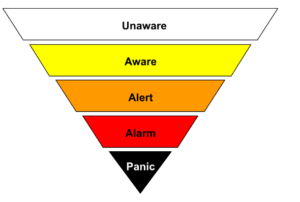
Situational awareness: A guide for journalists – Committee to Protect Journalists (cpj.org)
If you do not pay attention to your surroundings, you will not be prepared to deal with an emergency or unexpected change in your surroundings. As a consequence, you are more likely to be overwhelmed by a rush of adrenaline that can send you straight into the black stage of shock and panic. Therefore, avoid or minimize distractions—especially mobile phones—when on assignment. Be aware if you notice yourself slipping into the white/ unaware stage. Avoid threats as much as possible. If you are in the orange or red stage, be mindful of your location and try moving into a safer position. Come prepared. Your ability to analyze your environment and predict what is going to happen next will be greatly enhanced through contextual knowledge. What is the terrain like, where are the escape routes and positions of tactical advantage? Who are the actors on the ground, how can you distinguish them, and how are they likely to behave? What are the early signs of the situation deteriorating? Avoid working alone.
-Safety for women: risks in public spaces, domestic travel especially road travel, and accommodations.
-Knowledge of emergency protocols: clear procedures for handling security threats
Case example: Situational awareness during road travel
When traveling by car while abroad, it is important to be prepared and not to compromise your safety or security. For long trips by car in remote or poor areas, make sure to bring water, toilet paper, and hand sanitizer with you in case rest stops are not well equipped or hygienic. See “Chapter 1 : Preparing to travel abroad for work” for advice on finding information that can affect your stay at the destination; https://www.travelriskmap.com/#/planner/map
If you feel uncomfortable with how the driver is driving, regardless of the duration of the trip, it is best to communicate these concerns directly to the driver. You may need to speak with authority. Sexism can play a role in this type of communication, as drivers in some cultures may not be used to taking direction or feedback from female passengers. They may respond better if the feedback comes from a man.
Another option is telling the driver that you are feeling sick and that he needs to slow down to avoid you having to vomit. As no driver wants its vehicle to become soiled with vomit, he might be convinced to better slow down.
If you are feeling very uncomfortable and have concerns for your safety, depending on the situation you could ask the driver to stop in a crowded area where you may find another driver. Do not get out of the car in a remote area by yourself.
Regardless of whether you travel to remote areas or inside cities, traffic accidents caused by motorized vehicles can occur (see case study on Drunk driving in Mongolia). Awareness about how to behave in case of involvement in a traffic accident is adding to your personal safety and security. The best option is to travel with a professional driver with a roadworthy, functional and checked car, who is familiar with local traffic laws, level of respect of traffic laws by other drivers and traffic participants, who knows directions and local customs. Travelling with a local (rented car) or international institutional car (with a flag or logo) might ease your passage (reducing the danger of accidents), but occasionally reverts to the opposite. Driving on your own with a rented car is a safety and security issue in many locations. Before engaging in a road trip, try to enquire with local colleagues on safe and appropriate behavior, in case you are involved in a traffic accident, both, as a victim, as well as the offender, e.g. whether to get out of the car or not (and in which neighborhood yes or no), whether to drive first to the police station and return with police officer to the accident place, versus waiting for the police in lieu, whether an accident with an animal involved is an issue (e.g. a cow in India, a goat in a village), etc..
In remote rural areas or neighborhoods with underprivileged or angry populations, who have little trust in and little access to the police, self-administered justice can be dangerous.
Case study: Drunk driving in Mongolia
A female international expert was sent on a weeks long mission in Mongolia in the late nineties to do an inventory on the effect of the USSR collapse on veterinary services and on animal disease emergence, and to do a sectoral development needs assessment for future project development. Inland travel took place during the summer months, when a surplus of milk is fermented by women and sold as alcoholic beverages to men, leading to drinking parties. Men in the pastoral system work hard during the long winters and get rewarded with “sabbatical summers”.
The expert was accompanied by a senior local consultant and a driver, who was hired externally on a limited budget by a local NGO. During interviews at homesteads, the driver would disappear to secretly join the drinking parties. The driver was reprimanded severally to no avail, but sacking the driver was postponed. Distances were vast, so getting a new driver from the capital would take time and money and with lots of off-road driving from homestead to homestead, the risk for calamities was not assessed high.
However, one day, a rather steep and rocky slope had to be taken. The expert offered to take the wheel, since she had ample driving experience, also on rough roads in several countries. But the local senior consultant in charge of the expedition preferred the drunk driver to continue. With not many people driving cars in Mongolia, it may have been inconceivable for him that the still rather young women could be a good driver and that a foreigner could be familiar with terrain driving. However, his assumptions were not openly communicated and he said that he worried about the car insurance coverage, as if drunk driving would be covered, but she accepted it as a valid reason. The drunken driver drove fast downhill and hit a rock in long grass so hard that the car was launched and almost tumbled. When ordered to immediately stop the car, the driver didn’t, because he couldn’t. The brake line had broken. Fortunately, there were no curves ahead and the landscape eventually flattened. Another rock brought the car to a standstill, and no one got seriously hurt. A substitute driver and car had to come from the capital, which took four days. Double hiring of car and driver and four unproductive days in the field, made this a penny-wise and pound-foolish endeavour.
The bottom line is that a drunken or otherwise compromised or unskilled driver is never acceptable, irrespective of cultural contexts, differences in risk assessment, or budget. As an expert, being core to the mission, one can always refuse to enter the car when one feels the driving is not safe.
ii) Understanding local context and laws for safety and security
Before you travel, check your government’s website to be sure your work destination is safe to travel. For example, the US Department of State and various other countries provide up to date travel advisories to help inform travelers of safety and security risks in the country when planning a trip abroad.
- Learn about the culture of the destination i.e., establish cultural competence. For example, understand if there are dangers for women to travel without a companion (male or female). Establish if it is “culturally frowned upon” for a woman to travel alone in the destination country. If going to Spain, you may experience men propositioning you openly in the evening.
- Learn about the political situation and political history of the destination. If you are going into a war zone, for example into Ukraine you will need to set your security expectations differently then if you are going to vacation in Albania. If you are a US citizen you might need a different set of safety instructions, then if you are a French citizen going to the same country. Being mindful of political history between your own national belonging and the country you are visiting can also be an essential knowledge for security.
- Learn about the legal frameworks and definitions, as they are not the same across the world. In some countries, you are more likely to get into a security issue if you try to report harassment than if you don’t report it. Familiarize yourself with the local laws regarding harassment and how to report incidents. Note the contact details for your country’s embassy or consulate for emergencies.
- Research what to wear so you blend into your environment. If you stand out as a visitor, you become a more obvious target. Adapt to local dress codes (e.g., wearing a scarf in some regions) to help blend in and reduce attention.
- When you arrive at your destination, talk to the hotel concierge or a trusted colleague to learn if there are any places that you should avoid due to security concerns.
- Do not walk alone after dark unless you are quite sure it is safe. If you need to conduct meetings after dark, consider doing it at a public space in your hotel instead of somewhere remote.
- If you are going to a location that is questionable, always communicate with others to let them know where you are going and when you are expected to check back in with them. Be sure they know where you will be and how they can contact you.
- Make sure that you have a local SIM or your mobile phone plan includes that service coverage in the location. You can purchase an inexpensive plan or phone for the trip before you leave or when you arrive at the destination. Seek advice on where to buy local phone service etc.
- Always have an emergency contact number programmed into your phone and written down or memorized in case your own phone is not available at the time of the emergency.
- Consider using private transportation with licensed drivers. Ask the hotel to call a driver, use a trusted app such as UBER or GRAB (Asia), or use the same driver affiliated with your organization for the duration of your stay.
- In extreme cases, consider security escorts. It can also be helpful to receive training on ways to protect yourself.
- Use bags and/or purses that close securely to guard against theft. Special travelling bags to keep things close to your body are available.
- Only keep what you need on your person. It is helpful to have some cash in hand in specific destinations. If possible, it is better to keep non-essentials in a safe deposit box in your hotel room. Consider leaving sentimental items or expensive jewelry at home.
- Keep a separate amount of cash or additional access to money like a separate credit or ATM card in a safe deposit box in your hotel room. That way you have access to funds in case your purse or wallet is stolen.
- If you get lost, step into a café or shop before referring to a map. People who look lost can become easy targets.
- Do not leave drinks unattended because they can be at risk of being spiked i.e., a drug being dropped into the drink (see example on drug-assisted rape in the rape section for more information).
- Above all, consider safety first!
iii) Recognizing cultural differences in what constitutes harassment
By being culturally aware and prepared, women can reduce risks while traveling internationally and navigate challenging situations with confidence. See Chapter 3 on cultural and socio-economic aspects in general beyond harassment. Cultural aspects of harassment often stem from different societal norms, gender roles, and power dynamics. For women traveling internationally, it is essential to recognize and navigate these cultural nuances to stay safe and comfortable.
There isn’t a single recipe on how to manage uncomfortable or abusive working relationships, since the interactions are contextual and situational. There is, however, a pro memori: the interactions are taking place at a human level and a role level. The ones in power (unconsciously) play with confusing the two. Abusive relations at the workplace cannot always be avoided, and when falling victim to it, should be openly addressed (see case study on drawing a line to sexual and power harassment in a macho office culture).
Case study: Drawing a line to sexual and power harassment in a macho office culture
In an international office in Italy, it was a time when (young) female professionals were still a rare phenomenon, and they had to create a space for themselves to be able to do their work and not be harassed. The context was that of elderly men in a directing capacity and women in a serving capacity, as support staff, with an influence of a macho, elegant and flirting culture.
For the first time, a junior female professional entered this work situation, who had learned to stand her ground in a previous rather hostile job, where young women at the time had not lasted longer than two months in a position, and the men were proud of that.
One day, this young female professional knocks on the door of a senior male colleague and hears the reply: “Enter!” She enters the room with a file that she intends to discuss with him. Before she can say anything, he says ‘good looking legs’. She is astonished, but in a moment of clarity she says: “Let us do this again.” She steps out of the office and re-enters, immediately cutting to the chase about the file.
Working together has a role and a human dimension. By taking the lead over the situation, she pushed her senior back in his professional role. They got on well ever since.
Half a year later a young female intern joined the workplace. Being less experienced and feeling more dependent, she struggled with several men making remarks, sidelining her, blurring boundaries, making her do support staff work, etc. Her tactic was to trust one of the seniors and make him her protector. He would tell the men off, as a father whose daughter was offended. Paradoxically, this fatherly man would always stand too close to women and ‘inappropriately’ put an arm around them. Nevertheless, she used the human dimension to push her seniors back into a professional role.
Both women experienced problems with secretarial support and both resolved this by ‘investing’ in the human dimension. Instead of remaining confined to the situation of no or unwilling support, they found ways around it. By building a reputation of being ‘sympatica’, the top secretaries started sharing their network. There was always someone willing to give five minutes of their time to these young professional women.
Below are key cultural aspects of harassment and ways to mitigate them:
- Gender norms and expectations
- In some cultures, traditional gender roles dominate, leading to expectations about how women should dress, behave, or interact with men.
- In certain conservative societies, women may be expected to wear modest clothing and avoid direct eye contact with men (see Chapter 2 Packing list section on clothing). If you are going to the Vatican you will not dress in too revealing clothes as well as if you are going to Kabul you might choose to put on a scarf.
- Research local laws on gender, harassment, and discrimination.
- Research cultural attitudes toward foreigners, women, and non-binary individuals.
- Perception of foreign women
- In some regions, foreign women may be stereotyped as being more “liberal” or approachable, which can lead to unwanted attention. Other foreign women might be considered as more submissive and service oriented.
- Media portrayals often contribute to misconceptions about women from specific countries.
- Awareness of culture and race stereotypes can help you recognize and mitigate harassment
- Body language and communication
- Gestures, eye contact, or smiling might be interpreted differently across cultures. For example, what is considered friendly in one culture such as hugging may be perceived as flirtatious in another.
- In American and Latin American culture, it is natural for people to hug in a friendly way when they feel there is trust between them. Strangers often hug on first introduction as a way of expressing trust when the person is a friend of a trusted friend. Hugging is not always appropriate between work colleagues and in certain cultures. It can be misinterpreted as more than friendly, even when words indicate otherwise. See case study on hugging.
Case study: Hugging
Two colleagues were staying at the same hotel while on mission for two weeks. Her hotel room was on the 2nd floor and his hotel room was on the 3rd floor. One had to pass the 2nd floor by stairs in order to reach the 3rd floor. There was no elevator available in the hotel.
After dinner one evening, the male colleague walked the female colleague to her hotel room door. Upon saying goodnight, they embraced. While embracing, he asked her if he could come inside her hotel room. The female colleague was shocked. She told him she was not interested, and went inside her hotel room. She wrote to him directly after that if he made advances towards her again, she would report him. She was certain that because she made her intentions clear both verbally and in writing, that she would not have to worry about the incident repeating itself.
The next evening, a similar incident occurred. Again, she told him she was not interested, and went inside her room. This time, she was scared. He had disregarded her request for him to stop the behavior the first time, and she was now afraid for her safety. She confided in her colleagues about the incidents and learned that he had conducted himself similarly with other colleagues while on mission.
She decides to avoid her colleague for the remainder of the mission, working with him only on an as-needed basis. She spends free-time with other colleagues, especially in the evenings. She is within reason to report the incidents to HR, especially given that there were potentially similar incidents with other colleagues.
- Public space dynamics
- Women might face harassment in crowded areas, such as public transport, markets, or tourist attractions, particularly in regions where public harassment (e.g., catcalling) is normalized or not strictly penalized.
- Legal protections or lack thereof
- In some countries, laws against harassment may be weak or poorly enforced, leaving women with limited recourse in case of incidents.
- Navigate local law enforcement and understand their role in handling harassment.
- Cultural taboos around reporting
- Reporting harassment might be discouraged due to societal stigma, victim-blaming, or fear of retaliation. Discuss this with somebody you trust and remember that harassment is never OK!
iv) Further preventative measures for harassment
Prevention of harassment is exceedingly more beneficial than response to harassment. Prevention is cost-effective and can save people embarrassment, humiliation, and resources dedicated toward investigation of incidents. In order to prevent harassment, individuals should take accountability to ensure they are properly educated on harassment.
Here are further ways to mitigate harassment:
- Research and Preparation
- Learn about the cultural norms, dress codes, and attitudes toward women in your destination before traveling.
- Identify safe neighborhoods, transportation options, and any areas to avoid.
- Cultural Sensitivity in Behavior
- Avoid behavior that might be misinterpreted as overly friendly or intimate, such as excessive smiling or physical contact e.g., hugging
- Confidence and Assertiveness
- Walk confidently and appear self-assured to deter some forms of harassment.
- Practice polite but firm responses (e.g., “No, thank you” or “Please stop”) in the local language.
- Travel Safety Practices
- Travel with a companion or in groups when possible, especially in less populated or unfamiliar areas.
- Use reputable transportation services like registered taxis or ride-sharing apps.
- Stay in communication with team members.
- Select safe accommodations and transportation.
- Secure valuables and avoid common scams.
- Carry a whistle and/ or pepper spray for self defense and peace of mind. A whistle is effective at drawing attention from people nearby in an emergency situation. Note that in some countries, pepper spray is considered a weapon and could result in police investigation.
- Group Safety Strategies: Travel in groups and develop contingency plans.
- Engage Local Women
- Interact with local women to gain insights into cultural norms and tips for navigating safely.
- Women-only spaces (like train carriages or gyms) can be a safe refuge in some countries.
- Be aware of local women that are very open and try to approach you directly in public, offering to help you. It might feel unkind to reject their offer, but they may ask for a “reward” or try to pick-pocket you (e.g., Rome metro is known for these groups of young women; while one approaches you the others steels from your bag).
- Technology and Communication
- Share your itinerary with trusted friends or family and maintain regular communication with them.
- Install a safety application on your smartphone or carry a device, such as one with live location tracking or emergency features e.g., life360.
- Install a map application on your smartphone, such as maps.me, to use maps without internet connection
- Situational Awareness
- Stay alert to your surroundings, especially in crowded or isolated areas.
- Avoid wearing expensive jewelry or displaying valuables that might draw attention.
- See section on situational awareness for more information.
- Emergency Preparedness
- Have a plan for how to respond to harassment, such as moving to a more crowded area, seeking assistance from authorities, or confronting the individual calmly.
- Learn a few phrases in the local language to ask for help or signal distress.
- Build Alliances
- Consider connecting with fellow colleagues to exchange tips and advice.
- Engage in training
- Often mandatory or optional education on harassment is offered through the workplace. The context of this education is usually within the workplace and not outside the workplace. If a person’s workplace does not offer mandatory or optional harassment, it is recommended that you take the initiative to educate yourself on harassment both inside and outside the workplace. See the section below on available resources.
- Engage in pre-departure cultural sensitivity training to prepare mission teams with region-specific information.
B. Response strategies
If someone is constantly threatening you, following you, attempting to make sexual advances, or refusing to leave you alone, you need to learn how to protect yourself. Whether the person is a stranger or someone you know, start by telling the person that you don’t like the behaviour and asking them to stop.
General response strategies
The following response strategies can be used if you know the person or if there is more than one incident:
Name the behaviour and state that it is wrong. Start with verbal self-defence and non-confrontational responses. Clearly state to the harasser the specific thing they are doing and that the behaviour is inappropriate. For example, say, “Do not whistle at me, that is harassment,”,”I am not comfortable by the way you are touching me. Stop! That is harassment” or “Do not touch my butt. That is sexual harassment.”
Attack the behaviour, not the person. Tell them what they are doing that you do not like (“You are standing too close”) rather than blaming them as a person (“You are such a jerk”). Avoid cursing, name-calling, put-downs, and other actions that may escalate the situation unnecessarily.
Avoid making statements of opinion such as, “I’d like it if you didn’t touch me.” This can invite further conversation. Provide alternatives if necessary, such as, “You are standing too close. Please give me 3 feet of personal space.”
Tell the person to stop contacting you. If the person continues the unwanted behaviour, it might be time to break off contact. Tell the person that you expect them to stay away, and that you will no longer be answering correspondence. Be clear that if the person continues harassing you, you will take steps to put a stop to it. You might say, “Your behaviour is making me uncomfortable. Please don’t contact me again. If you do, I will call the police.”
Do not get into a dialogue with the harasser, or try to reason with them, or answer their questions. You do not need to respond to diversions, questions, threats, blaming, or guilt-tripping.
Voice your boundaries with someone you’ll see often. If the harasser is someone you have to see frequently—say, someone who works with you—you can still set boundaries that make sense for your situation. Tell the person to stop hanging out by your desk or approaching you at lunchtime, for example.
Stop answering the person’s calls, emails, and other messages. If the person tries to get in touch, don’t answer their calls, emails, or texts. At this point, you’ve made your position clear, so if the person continues to contact you, they are explicitly going against the boundaries you’ve laid out.
Remove the person from your phone and social media accounts. This way you’ll ensure the harasser no longer has access to you or the information you share with other people. Delete the person from your phone, and set up a block on that number if possible. Unfriend the person from your Facebook, Twitter, Instagram and other accounts.
There’s a chance the person may try to friend or follow you again using a different identity. Closely screen new connections and verify their identity before accepting any requests.
Use cultural allies: Leverage male companions or local contacts to defuse situations.
If the person has posted something disparaging about you, you can flag the post and alert the staff (of Facebook, Twitter, etc.) so that the post will be removed.
Keep records of the harassment. If you continue getting harassed, keep a written record of every incident that occurs, including the date, location, and witnesses. At this point, the harasser’s actions may be considered illegal, and if they continue you may need to get other people, such as supervisors, human resources, ethics officers, ombudsman, or authorities, involved. Having evidence of the behaviour can support your case. Keep all email and text correspondence you have received, especially regarding any boundaries you’ve set. Note any dates of significance, such as a day you asked for contact to stop, for example, and keep any records to back it up. Keep the names of people who have witnessed the harassing behaviour and those you told about the incident(s) in case you need to ask them to verify your account of what occurred.
Confide in your friends and family. In most international organizations there are complaints mechanisms in place that are safe. But still a lot of organizations do not have those mechanisms and reaching out to the Human Resources department is the route when the person harassing is a colleague or a superior. Going through this experience alone is dangerous and frightening. It’s important to tell the people in your life that you are being harassed, and that you’re fearful for your safety. Be sure to keep people in the loop about where you are on a daily basis so they’ll be aware if something out of the ordinary happens. Tell people you trust if you go out of town or need to miss work. Make sure people know not to give the harasser any information about you. Ask someone to stay with you. If you live alone and feel unsafe in your home, ask a friend or family member to stay with you. This may seem like a drastic step, but it could give you peace of mind. Plus, you should always take threats from a harasser seriously—if they’re threatened to harm you, they may try!
Use local support systems: Identify and utilize local resources including hotlines.
Protect your personal information online. Certain information-aggregator websites compile your personal information, such as home/work address, email, and phone number, which could be helping potential harassers locate you. Find this information on sites like Spokeo.com and have it removed. How to Deal with Someone Who is Harassing You (wikihow.com)
The woman next-door
A couple of years ago we had a workshop in Chiang Mai, Thailand and stayed in a nice hotel. In the evening when I was going to sleep around 10 pm I suddenly heard a lot of rumble in the room next to mine and heard a woman shouting and crying. I bang on the wall a couple of times but when the sound persists, I call the reception for somebody to see what is happening. As the screams get louder, I decide to go leave my room and bang on the door. A man opens the door and I see a woman kneeling on the floor next to him, holding her cheek. Without thinking, I grab the hand of the woman and pull her out of the room into my room and close the door behind me. She sits on the floor and sobs. I handed her a cold tin of drink from the mini-bar to put on her cheek that obviously had been hit by the man. We are not able to communicate and I wait until I hear the person from the hotel. What happened next, I can not recall anymore clearly but the woman leaves my room.
The next morning, when I come up after breakfast, I see that there is some substantial work being done to my next-door room, smashed items and even I see them painting parts of the wall. When I go to the reception to let them know that I would be available if they need a witness in case the woman has filed a complaint or so but the manager told me he saw both of them leaving the hotel in the morning as if nothing had happened….
It left me puzzled about the fate of this young (Chinese?) woman and what should I have done differently?
What to do if you are witness to harassment; how to intervene safely
Witnesses to harassment play a critical role in response strategies. They can take action in defense of the victim if the victim is unable to do so herself and they can provide written and verbal testaments to the incident(s).
Witnesses to harassment may be enabled to intervene on the spot. Witnesses can step in to defend the victim, even if the victim is a stranger. Such intervention is only advised if the safety of the witness is also ensured. There should be other people around. You should be able to get away from the perpetrator quickly. Witnesses can also call the police on behalf of the victim without getting directly involved.
If you are a witness to harassment, the victim may ask you to provide written and/or verbal testimony in the reporting procedure herself. Witnesses also have the option to report the incidents directly. It may be best to ask the victim herself first for permission to report the incident, even if she does not wish to report it herself. In extreme circumstances, it may be best to report the incident for the safety of the victim, even if she does not grant permission.
ii) Reporting harassment
Inform yourself of the reporting procedures, protocols and guidelines for reporting harassment if it has occurred with a work colleague. Documentation and evidence of the incidents will likely be requested. How to handle retaliation should also be addressed in the procedures. Guidance on steps to take if facing further harassment after reporting should be provided. The complainant and those who cooperate in a harassment investigation may have the right to be protected by the organization from retaliation (REF8). Retaliation against an individual for reporting harassment or for participating in an investigation of a complaint of harassment may be subject to an administrative or disciplinary action (REF1).
iii) Seeking support
-Accessing resources: explore local and virtual options for counselling and emotional support.
-Importance of having/developing support groups: importance of talking about it with friends/colleagues/network, offering support
-Importance of raising awareness about such issues encountered the workplace and beyond
Key takeaways of this Chapter
-
Traveling for work is an exciting opportunity and privilege that is often a strong motivation for one’s work. Risks to safety, security and wellbeing should not discourage women from engaging in work travel.
-
Major threats to women while they are traveling for work include harassment, gender-based violence and rape.
-
Threats to safety, security and wellbeing are best avoided through thorough prevention measures: Situational awareness, understanding local context and laws for safety and security, and recognizing cultural differences in what constitutes harassment
-
Know the policies and procedures of your organization before an incident occurs
-
In the event of an incident, confide in friends, colleagues, HR and/ or supervisor. Refer to your organization’s policies for guidance on next steps.
D. Resources
Resources (guidance documents, Both UN and non-UN)
- GIZ
- FAO. 2024. FAO Code of Ethical Conduct. Second Edition. Rome. https://openknowledge.fao.org/server/api/core/bitstreams/9dd45a29-f705-4209-9453-21a4c5d970bd/content
- FAO. 2015. Administrative circular: POLICY ON THE PREVENTION OF HARASSMENT, SEXUAL HARASSMENT AND ABUSE OF AUTHORITY. https://openknowledge.fao.org/server/api/core/bitstreams/88a6d25a-ae9c-4eaa-bb36-864a293494d8/content#:~:text=FAO%20is%20committed%20to%20ensuring,treated%20with%20respect%20and%20dignity.
- Violence and harassment at work: a practical guide for employers | International Labour Organization
- Women at Work podcast also available on YouTube
- She Thrives: A Safety in the Workplace Podcast available e.g., on Spotify
Trainings (Both UN and non-UN)
- OpenWHO trainings
Sexual harassment
United Nations Department of Safety & Security (UNDSS)
- Safety and security in all six united nations languages
- Training catalogue: https://training.dss.un.org/thematicarea
- WHO security trainings
Disclaimer: These are recommended trainings and not explicitly endorsed by WfOH
- References
- FAO. 2015. Administrative circular: POLICY ON THE PREVENTION OF HARASSMENT, SEXUAL HARASSMENT AND ABUSE OF AUTHORITY. https://openknowledge.fao.org/server/api/core/bitstreams/88a6d25a-ae9c-4eaa-bb36-864a293494d8/content#:~:text=FAO%20is%20committed%20to%20ensuring,treated%20with%20respect%20and%20dignity.
- Beta 80 group. 2023. Safety vs Security: what is the difference between protection and prevention? https://news.beta80group.it/en/safety-vs-security-what-is-the-difference-between-protection-and-prevention#:~:text=Safety%20and%20security%20are%20two,as%20accidents%20or%20natural%20disasters.
- LSE. Human Security: An approach and methodology for business contributions to peace and sustainable development. https://www.lse.ac.uk/ideas/Assets/Documents/project-docs/un-at-lse/LSE-IDEAS-Human-Security-Background.pdf
- Health promotion glossary of terms 2021. Geneva: World Health Organization; 2021. Licence: CC BY-NC-SA 3.0 IGO. https://www.who.int/publications/i/item/9789240038349
- Situational awareness: A guide for journalists. Committee to protect journalists. https://cpj.org/2023/07/situational-awareness-a-guide-for-journalists/
- UNICEF. Gender-based violence. https://www.unicef.org/protection/gender-based-violence-in-emergencies. Accessed 9 May 2025.
- UNHCR. Gender-based violence. https://www.unhcr.org/what-we-do/protect-human-rights/protection/gender-based-violence. Accessed 9 May 2025.
- FAO Whistleblower Protection Policy Administrative Circular. August 2023. https://openknowledge.fao.org/server/api/core/bitstreams/12ae2caf-776e-4e72-8abe-50443490e936/content[Text Wrapping Break]
- Ladkin, Donna. 2020. Rethinking Leadership: A new look at old questions. Edward Elgar Publishing. ISBN 978 1 80037 730 1. Doi: 10.4337/9781788119320